
A tilted roller drives the carriage forward, and a timed cam strike flips its angle to reverse the motion automatically.
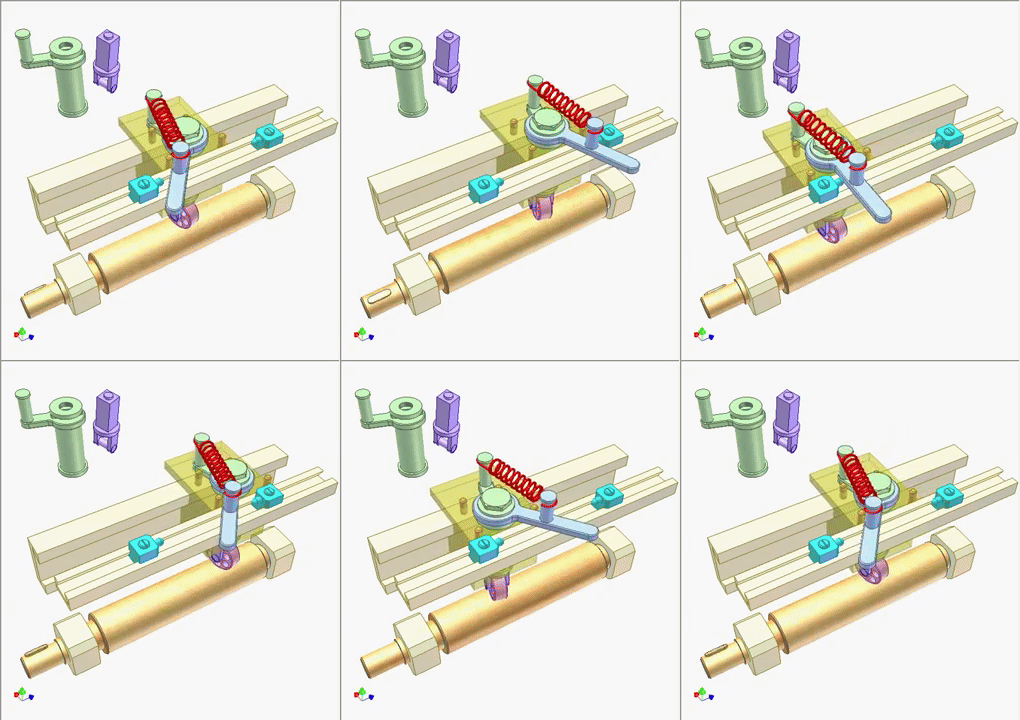
This mechanism uses a skewed friction roller to translate the rotation of a shaft into linear motion. The brass shaft rotates continuously, while the small roller above it is tilted at a deliberate angle. A spring pushes the roller downward, keeping it firmly pressed against the spinning surface. Because the roller¡¯s axis is skewed relative to the shaft, the contact point generates a sideways component of force that pulls the carriage along the guide rails.
Components — Brass rotating shaft, purple angled friction roller, red compression spring, yellow carriage block, guide rails with mounting clamps, and upper adjustment fixtures.
How it works — When the shaft rotates, the angled roller¡ªforced into contact by the spring¡ªexperiences friction that makes it spin and simultaneously generate a tangential component parallel to the rails. This tangential component drives the yellow carriage forward or backward depending on the roller¡¯s tilt direction. Since the roller is free to rotate while being pressed against the shaft, the system converts rotational energy into precise, slip-regulated linear travel, with the spring maintaining consistent normal force for reliable friction engagement.
Applications — Precision positioning stages, low-cost feed mechanisms, lightweight conveyors, fine adjustment systems, and devices needing quiet, vibration-free translation without gears or screws.
Why it matters — Unlike gear trains or lead screws, a spatial friction drive introduces no backlash and can operate quietly with minimal mechanical complexity. Its ability to provide smooth, continuous linear motion from a rotating input makes it ideal for compact automation tasks or rapid prototyping setups where simplicity and adjustability are key.
