
A slanted rotating disk that sweeps and redirects airflow with each revolution
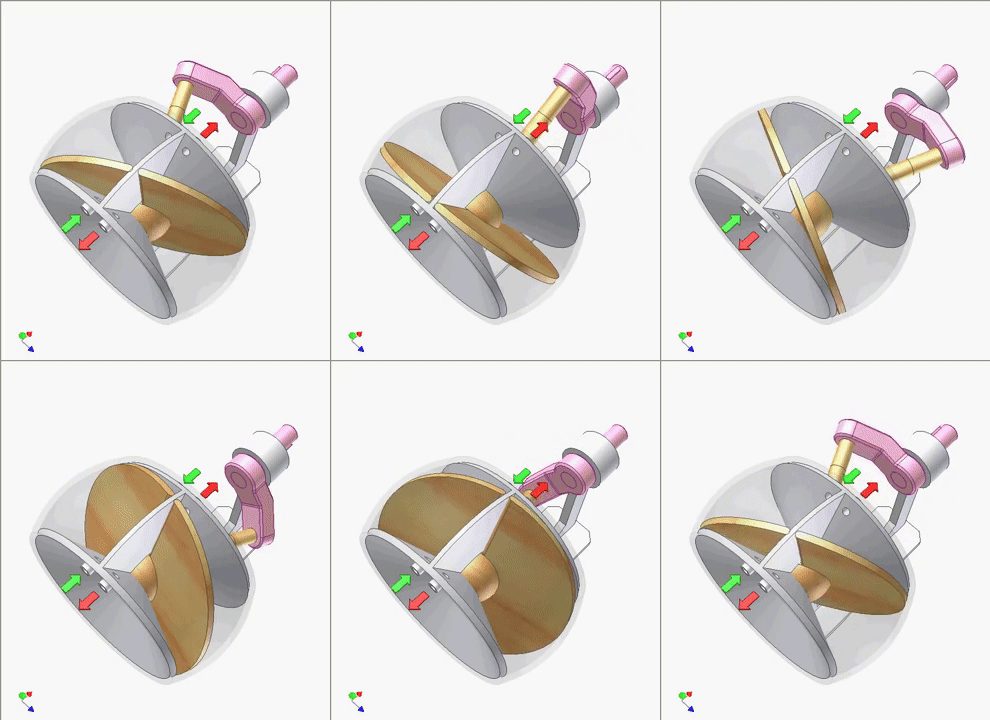
This mechanism uses a tilted rotating disk to create a rhythmic, alternating airflow pattern. Instead of spinning flat, the disk rotates on a slanted axis, which causes its surfaces to sweep closer to and farther from the surrounding housing. That uneven spacing catches and redirects air, pushing it outward through alternating sides. The colored arrows in your animation show exactly this: one region pulls air in, while another pushes it out, and as the wobble rotates, those regions shift continuously.
Components — The angled gold disk, the surrounding gray shell that guides the air, the pink follower/drive arm at the top, and the ports on each side where air is alternately drawn in (green) and expelled (red).
How it works — Because the disk is tilted, one side approaches the housing while the opposite side retreats. The closer region compresses and pushes air outward (red arrows), while the farther region draws air in (green arrows). As the disk rotates, this push–pull relationship moves around the circumference like a traveling wave. The follower arm rides the disk’s varying height, staying synchronized with the tilt and ensuring stable motion. The result is a directional airflow that oscillates naturally with each revolution—no valves, no timed shutters, just the rotating geometry itself.
Applications — Compact air pumps, pulsed coolers, ventilation modules, small fluid-moving mechanisms, and kinetic devices that need alternating or sweeping airflow.
Why it matters — It creates a modulated airflow pattern using only a single rotating disk and carefully shaped geometry. The oscillation and pumping effect emerge automatically from the tilt—simple, quiet, and mechanically efficient.